 Contact
 Donate
 Languages
 Events

 Visit Greenways
 Future Projects
 Get Involved
 How We Work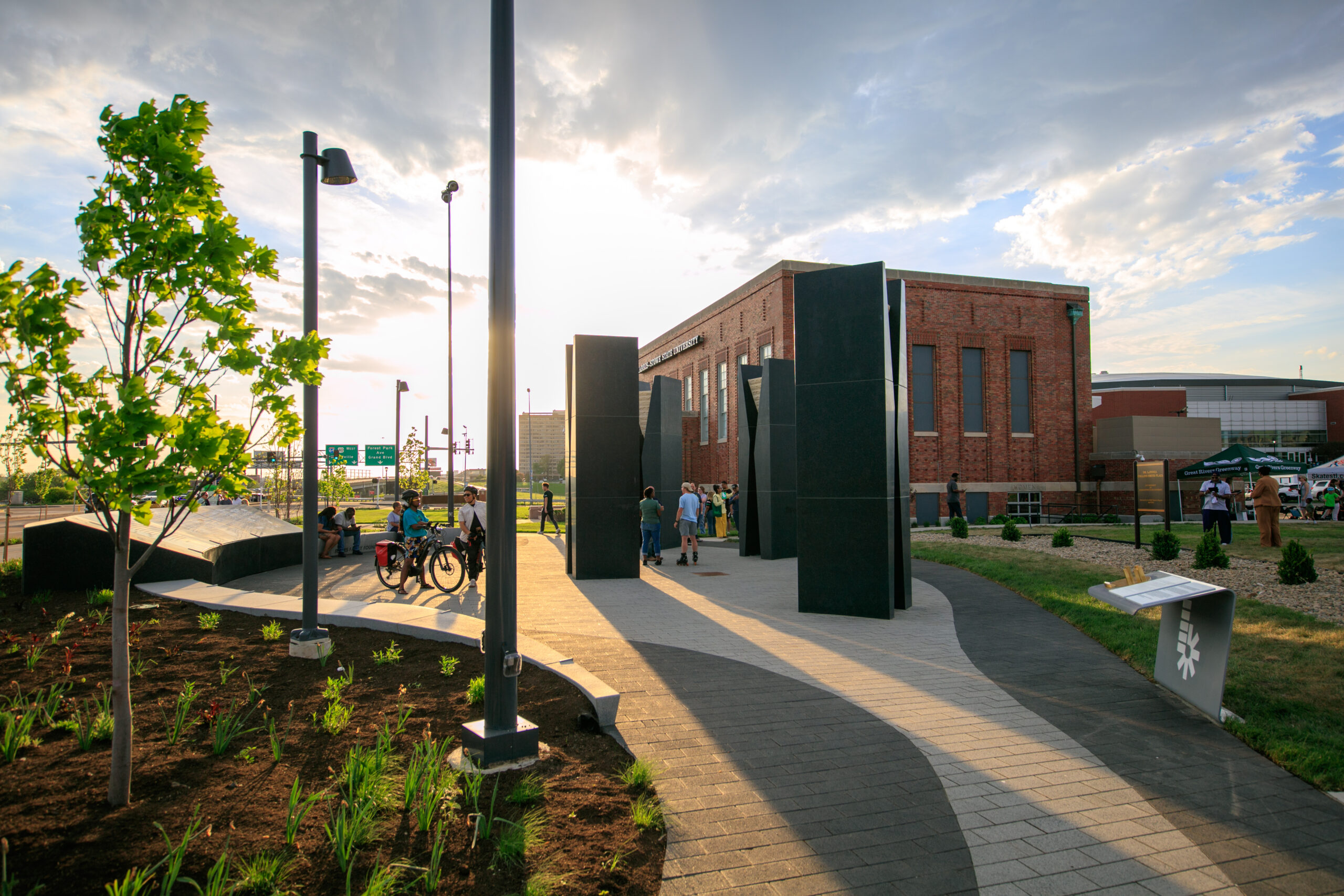
On this page, you’ll find some of the history, ecology and public art that makes this place special. If you’d like to learn more, there are books, videos, exhibits and news articles available here.
History of Mill Creek Valley
The Making of Mill Creek Valley
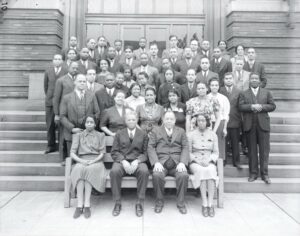
1939 high school faculty in Mill Creek Valley, image source: Missouri Historical Society
Many of the homes in Mill Creek Valley were built by families who emigrated from Europe in the late 1800s and then moved out in the early 1900s as many Black families moved from Southern states to Mill Creek Valley. By the 1950s, 20,000 people (95% Black) lived in this community and built an abundance of businesses, houses of worship, doctor and lawyer offices, community organizations, and schools.
The Taking of Mill Creek Valley
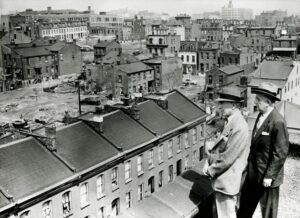
Demolition Bond Chair Maestre and Mayor Tucker overlooking Mill Creek Valley in 1956, image source: Missouri Historical Society
Racially restrictive covenants and redlining created a housing shortage for people of color in St. Louis, confining many Black families to areas like Mill Creek Valley. In 1947, the City of St. Louis labeled many of these neighborhoods as blighted and planned their demotion to prioritize new roads for commuter access. Federal housing and highway funding accelerated displacement, uprooting over one million Black and Brown people nationwide. Local leaders framed Mill Creek Valley negatively to justify its demolition which began in 1959. Of the 5,700 homes and over 800 businesses that once stood in Mill Creek Valley, only five remain, leaving lasting social and emotional devastation.
Community and Culture
Booker T. Washington Theater audience in 1918, image source: National Association for the Advancement of Colored People (NAACP)
During the first half of the twentieth century, this was a predominantly Black neighborhood where many residents owned their own businesses and held great economic power. Ragtime music that influenced the jazz, blues, soul, and hip hop that defines American music today was born in the restaurants and bars that once stood where the Brickline Greenway is built today.
Championing Civil Rights
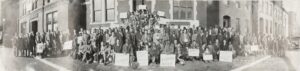
League of Struggle for Negro Rights in 1930, image source: Missouri Historical Society
Mill Creek Valley was a hub for Black political organizing and civil rights strategizing. Many organizations worked together to promote the autonomy and wellness of Black people and advocate for issues such as anti-lynching legislation, ending police brutality, and equal pay for equal work.
Pillars of the Valley
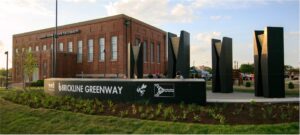
Pillars of the Valley is a mile-long permanent public art installation along the Brickline Greenway on Market Street, from Compton Avenue at Harris-Stowe State University to 20th Street at Energizer Park soccer stadium. It commemorates the once-thriving Mill Creek Valley neighborhood, which was destroyed (and 20,000 Black residents displaced) in the name of “urban renewal” in the late 1950s and early 1960s.
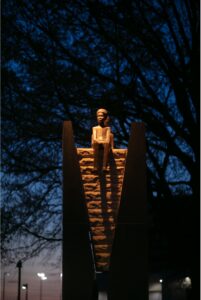
This art installation was created by Damon Davis with support from partners Great Rivers Greenway, St. Louis CITY SC, City of St. Louis, and Harris-Stowe State University. The Pillars were thoughtfully curated with input from former residents and current stakeholders, plus support and expertise from institutions like The Griot Museum of Black History and Missouri Historical Society and contributions from generous donors.
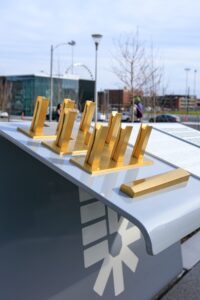
Pillars of the Valley are hourglass-shaped monoliths, a testament to the pillars of the community that made the neighborhood thrive. They’re meant to be holding up the residents’ stories, excavated from the earth, never to be lost to the sands of time again. Inside each pillar (and along the greenway path) are quotes from the people who lived there.
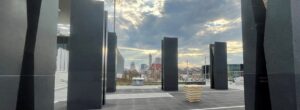
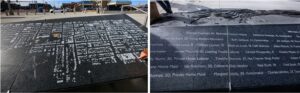
Granite plinths include Damon Davis’ artist statement, a map showing the density of the neighborhood, and the name, age, and occupation of everyone who lived in that block, plus a relief of Mill Creek, a waterway now buried underground, flowing to the Mississippi River.
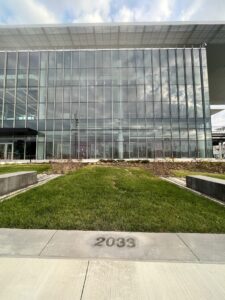
The benches and bushes outside Energizer Park outline the parcels where homes and businesses once stood, with their address number embedded in the walkway.
A braille and a tactile model are available in three locations, enabling those with low or no vision to experience the artwork.
Stars Park Mural
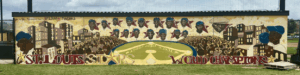
In summer 2025, Great Rivers Greenway, Harris-Stowe State University and St. Louis ArtWorks (local artists with teen apprentices) teamed up to create a mural along the Brickline Greenway at Stars Park to honor the St. Louis Stars, who won 3 Negro National League pennants, and the Mill Creek Valley community who supported them.
This mural can be seen along the Brickline Greenway just east of Compton Avenue.
Watch the video about the project here.
Mill Creek Waterway
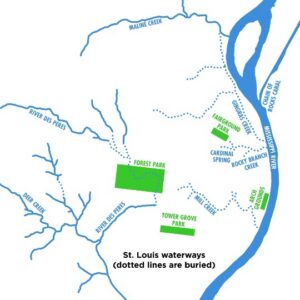
Image Source: Great Rivers Greenway
Beneath this segment of the Brickline Greenway, a buried creek is flowing into the Mississippi River and out to the ocean. This waterway has gone by many names including Mill Creek, and it created the east-west valley through the center of St. Louis that generations of people have traveled through and lived in. The creekbank provides a flat surface for many modes of travel, and many modern roads are built on routes created by Native American Peoples. This segment of Market Street is built on the Osage Trail.
Plants

Image source: Great Rivers Greenway
Many of the plants along the Brickline Greenway are native to the prairie habitat that once covered most of St. Louis. Today, less than 1% of prairies in North America remain. Native prairie plants help St. Louis by absorbing stormwater to reduce flooding and erosion, storing carbon underground to fight climate change, and supporting native insects that pollinate plants and feed wildlife.